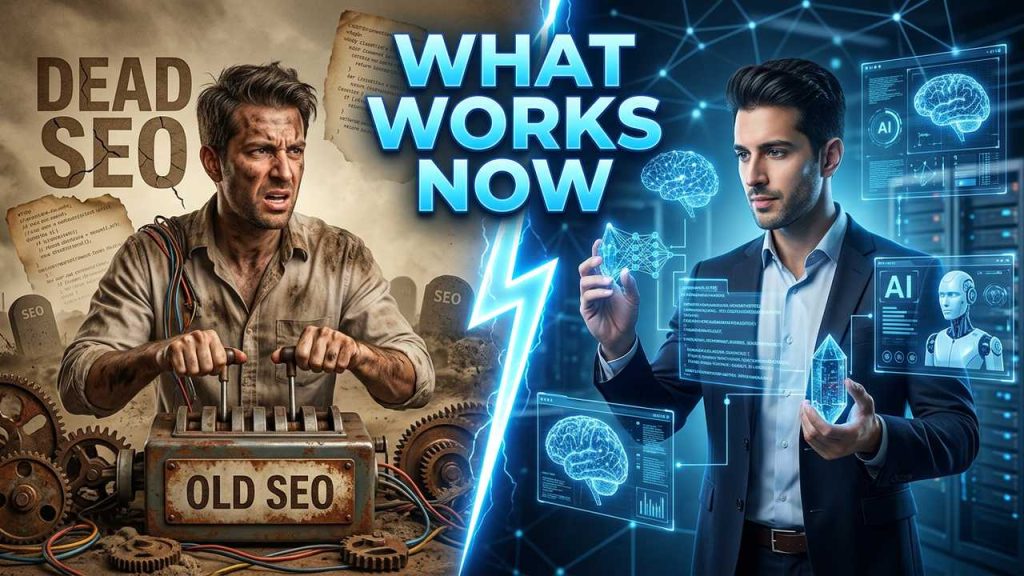
Is SEO dead? No. But the version that relied on shortcuts is dying, and fast.
That's the honest headline. Every year someone declares SEO dead, and every year the declaration is wrong in the same way — it mistakes the death of a tactic for the death of the discipline. What actually happened through 2026 is narrower and more useful to understand: Google got dramatically better at neutralising the cheap stuff, the shortcuts stopped competing with the real work, and as a result a small number of durable things now work better than ever — precisely because the noise cleared out.
This is the clear-eyed version. What changed, what died, and what to build instead — across both Google and AI answers.
The short version: "SEO is dead" is wrong. Search and AI visibility have converged onto the same foundation, and Google spent 2026 neutralising the shortcuts that used to compete with genuine work. Parasite SEO, scaled AI content, and cheap link schemes stopped working. Authority, non-commodity content, technical clarity, and brand signals now work better than before — because the shortcuts aren't crowding them out anymore.
"SEO is dead" — and the numbers that disagree
The claim usually rests on AI Overviews eating clicks. That's a real pressure, but the conclusion drawn from it is backwards.
Here's what the data actually shows: search and AI visibility didn't split into two disciplines — they converged onto one. A May 2026 analysis by Cyrus Shepard, scoring 23 factors across 54 studies, found that classic search rank predicts whether a page gets cited in AI answers at 9.4 out of 10 — second only to basic URL accessibility. In plain terms, the same signals that rank you in Google are the signals that get you cited by AI. The major AI answer engines ground their responses in classic web search. Being strong organically is now the prerequisite for being visible in AI, not an alternative to it.
So SEO didn't die. It absorbed AI search. The work that earns one increasingly earns both — which is exactly why we treat AI search visibility as an extension of core SEO rather than a separate bolt-on.
What actually changed: the 2026 enforcement wave
2026 was one of the most aggressive enforcement years in Google's history — multiple broad ranking incidents in the first quarter alone. The updates weren't random. Each one targeted a specific shortcut:
- Scaled content abuse — mass-generated pages, hit hardest by the March 2026 core update (60–80% traffic drops for content farms).
- Link schemes — continuously reassessed by SpamBrain, now evaluated as patterns across a whole profile rather than link by link.
- Site reputation abuse — the parasite-SEO crackdown, expanded and tightened.
- AI-answer manipulation — as of 15 May 2026, Google's spam policies formally extended to generative AI responses (AI Overviews and AI Mode), putting the AI layer under the same enforcement as classic results.
The through-line: Google didn't just add penalties. It got better at making the shortcuts not work in the first place. That distinction is the whole story of what died.
What died
Parasite SEO (site reputation abuse)
Renting a trusted host's authority to rank content that couldn't rank on its own. Google named a policy after it, then in November 2024 removed the "we oversee the content" defence — using third-party content to exploit a host's ranking signals is now a violation regardless of first-party involvement or oversight. Major publishers running third-party affiliate subdirectories were the high-profile casualties. The tactic that let you borrow someone else's trust is closing off, variation by variation.
Scaled AI mass content
The "point AI at a keyword list and publish a thousand pages" play. It died on contact with the March 2026 core update. The nuance that matters: Google doesn't penalise AI content — it penalises scale without value, however it's produced. Depth survived; volume didn't. (We wrote a full breakdown of why depth beats volume and how topical authority actually works — it's the single most important shift to understand if you publish content.)
Cheap link schemes — neutralised, not just penalised
This is the most misunderstood death, and the most important. Are backlinks still important? Yes — enormously. But cheap links changed status entirely.
The old model was: buy links, risk a penalty, manage the risk. The 2026 reality is different and worse for the buyer. SpamBrain now neutralises manipulative links rather than penalising them — it strips their ranking value so they pass zero authority, silently, with no manual action to "fix." The asymmetry is brutal: because there's no penalty to lift, there's nothing to recover. The credit those links passed is gone and, by Google's own framing, cannot be earned back. Bought links didn't become risky — they became a dead asset.
This is the mechanic behind why raw Domain Rating stopped being a useful buying signal on its own: SpamBrain discounts exactly the high-DR-on-unrelated-sites pattern that cheap vendors sell. It's why our link work runs every placement through the Growify Authority Index — real traffic, topical relevance, and profile health, not a DR number a vendor can inflate. Done that way, guest posts and niche edits still compound. Bought by the hundred on metrics alone, they now compound to nothing.
Bolt-on "AI" files and markup — llms.txt
The tidiest death of all, because it never actually worked. Through 2025, thousands of sites added an llms.txt file on the promise that it would help AI systems understand and cite them. The 2026 evidence is unambiguous: an Ahrefs study of 137,000 sites found 97% of llms.txt files received zero traffic; an SE Ranking analysis of ~300,000 domains found no correlation between having the file and being cited in AI answers; AI crawlers don't even request it. Google's John Mueller compared it to the discredited keywords meta tag, and Gary Illyes confirmed Google doesn't support it and isn't planning to.
The lesson generalises beyond one file: there is no markup shortcut to AI visibility. Bolt-on signals that a site declares about itself are exactly the class of signal search engines learned to ignore fifteen years ago. AI systems read your actual content, not your claims about it.
What still works — better than ever
Here's the good news buried in all that enforcement. When the shortcuts stop competing, the real work faces less noise. These four now work better than they did, not worse.
Genuine authority
Demonstrable expertise and earned trust — E-E-A-T, in Google's terms — now applies across every content type, not just health and finance. Real first-hand experience, transparent authorship with actual credentials, original analysis a content farm can't fake. This is the foundation everything else sits on, and it's the one thing that can't be manufactured at speed.
Non-commodity content
Content that says something the other ten results don't. Original data, genuine expertise, a real point of view. The commodity middle — the competent, generic, could-be-anyone page — is exactly what both the March update and AI Overviews compressed. Depth and originality are what survive, which is the entire premise of a real content strategy: own a topic completely rather than dabble across a thousand.
Technical clarity
Not clever technical tricks — technical clarity. Clean crawlability, correct indexation, coherent structure, genuine schema. AI systems and Google both reward content they can retrieve, parse, and trust with the least effort. A site that's structurally clear is easier to rank and easier to cite. It's the least glamorous work and one of the highest-leverage, which is why every engagement we run starts with a site audit.
Brand and entity signals
The strongest durable lever, and the one most aligned with AI visibility. A recognised entity — consistent brand, real mentions across trusted sources, a coherent identity Google and LLMs can resolve to you — is what earns citations in AI answers and what makes classic rankings resilient. Building that recognition, and defending it, is core to brand protection and to how modern authority is actually built.
How we execute against this
None of the above is theory for us — it's the operating model. The shape is deliberately simple because the durable work is simple (simple, not easy):
Diagnose first. A detailed site audit establishes what's actually holding a site back — technical, content, or profile — before a euro is spent building anything.
Build authority the way that survives a SpamBrain pass. Links vetted through the Growify Authority Index, not bought on DR. Content built for depth and topical ownership. Entity and brand signals reinforced over time.
Then, and only then, the closer. Once a page has genuinely earned its position, Viral Social Boosts can act as the engineered final push at the moment it's ready to move — geo-targeted, applied to something real. It's a closer, never a foundation. On a page that hasn't earned its place, it's the wrong tool, and we'll say so.
That sequence is the whole GrowifyLabs solutions catalogue in miniature: diagnose, build durable authority, amplify what's earned.
Watch the video
This post accompanies our full video walkthrough of what died in 2026 and what still earns durable visibility.
The bottom line
SEO isn't dead. The shortcut version is — parasite SEO, scaled AI content, cheap link schemes, and bolt-on AI files all stopped working, most of them because Google got good enough to make them simply not count rather than merely risky. What replaced them is the thing that was always underneath: genuine authority, non-commodity content, technical clarity, and brand.
The reason that's good news is subtle. When the shortcuts competed, they crowded the results with noise and forced honest sites to fight volume with volume. Now that the noise is being neutralised, the durable work faces a clearer field than it has in years. The marathon didn't get harder. The sprinters just stopped finishing.
If you want to know where your site stands against this — what's already working and what's quietly dead weight — start at growifylabs.com, or go straight to a site audit. And if you've been sold one of the dying tactics, that's worth a conversation before the next update makes the point for us.
FAQ
Is SEO dead in 2026?
No. What's dying is the shortcut version — parasite SEO, scaled AI content, cheap link schemes, and bolt-on files like llms.txt. The discipline itself is stronger, because search and AI visibility converged onto the same foundation: genuine authority, quality content, technical clarity, and brand signals. Analysis of 54 studies found classic search rank predicts AI citation at 9.4 out of 10.
Does llms.txt help with AI search visibility?
No. As of mid-2026, no major AI provider reads llms.txt in production. An Ahrefs study of 137,000 sites found 97% of llms.txt files received zero traffic, and an SE Ranking analysis of ~300,000 domains found no correlation with AI citations. Google's John Mueller compared it to the discredited keywords meta tag. AI systems read your actual content, not a file declaring what your site is about.
Are backlinks still important in 2026?
Yes — but the type matters more than ever. SpamBrain now neutralises manipulative links rather than penalising them: it strips their ranking value so they pass zero authority, and that credit cannot be recovered. Earned, relevant, editorially-placed links still compound. Cheap links bought on Domain Rating alone are now effectively a dead asset.
What still works in SEO in 2026?
Four things, now working better because the shortcuts stopped competing: genuine authority and expertise (E-E-A-T), non-commodity content with original value, technical clarity (clean crawlability, indexation, and structure), and brand and entity signals. These are also the strongest predictors of visibility in AI answers.
Is AI search replacing traditional SEO?
No — it's converging with it. The major AI answer engines ground their responses in classic web search, so the signals that earn Google rankings are largely the same signals that earn AI citations. Strong organic SEO is now the prerequisite for AI visibility, not a separate discipline.